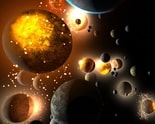
Universe Sandbox 2 looks, from the name alone, like a serious astronomy tool for studying orbital mechanics and stellar physics. What you actually get when you load it is closer to a demolition toybox: point a black hole at a planet, drop an antimatter missile on a continent, or aim a meteor at the equator and watch the surface crack apart into glowing chunks. The gap between the studious name and the destructive reality is the whole appeal of the game.
Planet Smash vs System Smash in Universe Sandbox 2
The experience splits into two clearly different modes. Planet Smash drops you in front of a single world with a weapon menu and nothing else to manage, which is where almost everyone starts and where most of the destruction happens: pick a weapon, aim, fire, watch the planet respond.
System Smash pulls back to a wider view where multiple planets, moons, and stars share the same space under real gravitational pull. Instead of causing damage directly, you set up a collision or an unstable orbit and let physics do the rest, which plays slower and rewards patience over reflexes.
Most players treat Planet Smash as the main event and System Smash as the curiosity cabinet they visit once the novelty of blowing up one world fades. Both modes run on the same physics engine, part of why switching between them never feels like a different game.
Reading the Black Hole’s Voxel Removal
The black hole is one of the most requested weapons in player discussion because of how it behaves, not how strong it is. Drop one near a planet and it enlarges itself, then strips away material within roughly twice its own visible radius before shrinking and disappearing, leaving a clean gravitational wound instead of scattered debris.
Newer players often expect the black hole to be the single most destructive option simply because of its reputation, and are surprised that slower, more methodical tools like sustained meteor strikes can erase more surface area over time. Its appeal is the visual, not raw efficiency.
Because nothing escapes it, watching a black hole finish its pass is a small detail players specifically bring up when talking about Universe Sandbox 2, since debris never scatters outward the way it does with almost every other weapon.
Antimatter Missiles and the Blue-Orb Implosion
Antimatter missiles play out differently from anything else in the arsenal: on impact, a blue orb expands outward, then folds back inward in an implosion that destroys everything within range and leaves a crater roughly comparable in scale to a large lunar impact. It is one of the more cinematic weapons and a common answer when players are asked which strike looks best.
Unlike straightforward explosive weapons, the antimatter missile rewards watching the whole sequence rather than firing and immediately reloading. The implosion phase is where the destruction actually happens, and cutting away before it finishes means missing the payoff.
Players experimenting with weapon combinations often save an antimatter missile for last on a planet already softened up by lasers or railgun fire, since the implosion reads more dramatically against a surface that is already cracked open.
Scaling Meteors From Nuisance to Continent-Killer
Meteors are the clearest lesson in scale that Universe Sandbox 2 teaches through experimentation rather than any tutorial text. A small rock barely dents a planet’s surface, hitting with roughly the force of a modest nuke, while the largest sizes rip out entire continents in one strike.
Both size and velocity can be adjusted before impact, and pushing size to its maximum setting is enough to visibly wipe out roughly half a planet in one hit. That single slider teaches players more about impact scaling than any other weapon.
Early on, most players fire meteors at default settings and are mildly underwhelmed, a common early complaint. The moment they push the size slider up is usually when the weapon clicks and becomes a favorite instead of an afterthought.
Railgun Salvos and Clearing a Hemisphere Fast
The railgun trades single-hit spectacle for speed. It fires rapid sequential strikes across the surface rather than one large impact, making it the practical choice for clearing an entire hemisphere before switching to something bigger for the finishing blow.
Speed-focused players open with a railgun salvo because it works fast without waiting on a slower weapon like an antimatter missile to finish.
Compared to the black hole’s methodical pacing, the railgun feels almost frantic, and that contrast between weapon personalities is a big part of why the arsenal in Universe Sandbox 2 rewards experimenting rather than settling on one tool.
Giant Monsters, Space Shibas, and the Novelty Weapons
Not every weapon is about efficient destruction. A handful exist purely for spectacle, and player communities talk about them as much as the serious tools.
- Giant monsters that crawl across a planet’s surface causing localized damage as they move.
- Space shibas, a purely novelty projectile players use for laughs rather than efficiency.
- Laser swords and celestial beings, both closer to toys than weapons in the traditional sense.
- Defensive shields and satellites, which exist to protect a planet rather than destroy one.
These novelty options are often the first thing new players show off to friends, since a giant monster stomping across a globe reads immediately even to someone who has never touched the game before. Serious runs set them aside once the laugh wears off.
Why Universe Sandbox 2 Has No Win Condition
One of the most honest criticisms leveled at the game is that there is nothing to actually win. There is no score, no level to clear, no unlockable ending; the whole structure is an open sandbox where the only goal is whatever you decide to attempt. For players expecting a progression system, that absence is a genuine letdown worth acknowledging.
For everyone else, the lack of a win condition is the draw. Universe Sandbox 2 hands you a fully destructible planet and dozens of ways to end it, and satisfaction comes from watching physics respond convincingly, not from clearing an objective.
That choice also explains why sessions vary so wildly in length. Some players spend two minutes detonating a single meteor and move on, while others build a full System Smash scenario just to see how the gravitational chaos resolves.
Thermal States and Why Debris Behaves Differently Each Time
Underneath the weapon menu, the game tracks molten and frozen states per region of a planet rather than treating the surface as one uniform material, which is why the same weapon can look different depending on where it lands. A strike on a molten region produces glowing, flowing debris, while a frozen region shatters more like brittle rock.
This layered simulation is also why destruction propagates unevenly through a planet’s structure instead of a perfect circle. Explosions travel along weaker geological layers first, a detail attentive players notice once they compare repeated strikes on the same spot.
It is a small technical touch, but it is the difference between Universe Sandbox 2 feeling scripted and feeling like a real simulation reacting to where you aimed.
- What is the strongest single weapon in Universe Sandbox 2? There is no single strongest option; the antimatter missile does the most concentrated damage per hit, the black hole removes material most cleanly, and a maximum-size meteor can wipe out roughly half a planet in one strike, so it depends on whether you value speed, cleanliness, or scale.
- Does Universe Sandbox 2 have a multiplayer mode? No. Every weapon, planet, and System Smash scenario is single-player, which is a common point of confusion for players expecting a shared destruction mode.
- What is the difference between Planet Smash and System Smash? Planet Smash isolates a single world for direct weapon testing, while System Smash simulates multiple gravitational bodies at once, letting collisions and orbital decay do the destruction instead of a weapon you fire.
Whatever your reason for loading it up, Universe Sandbox 2 keeps circling back to the same loop: pick a weapon, watch a planet respond, and immediately want to try something bigger, whether that means a black hole on the next world or finally testing a maximum-size meteor on a moon.