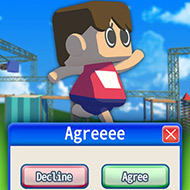
The countdown timer in Agreeee does not wait for you to click Agree—it starts the instant the agreement popup appears, which means most first-time players lose their opening attempt before they’ve even read the terms.
The Twelve Terms and Conditions in Agreeee
Every session opens the same way: a set of 12 terms and conditions that must be accepted one at a time before the actual game begins. These aren’t formality screens meant to be clicked through on autopilot—each one is built with a hidden gimmick, and the game gives no indication up front which screens are straightforward and which are traps. Some agreements hide their real Agree button behind a misleading label, while others require the player to notice a detail elsewhere on the screen before the button becomes clickable at all. Rushing through the twelve screens the way most people rush through real terms and conditions is the single most common way new players fail before the game has properly started.
Passing all twelve is treated as the true first challenge, not a prelude to one.
Decoy Buttons and Why Habit Fails You
Decoy Button: an on-screen element labeled Accept or Next that visually matches the real confirmation control but does not register the expected input.
Decoy Buttons are one of the clearest examples of how Agreeee weaponizes muscle memory. Anyone who has clicked through dozens of real terms-and-conditions popups has trained a habit of tapping wherever the confirm button usually sits, and this game exploits exactly that assumption. A screen might present two nearly identical buttons, only one of which is functional, or place the real control somewhere a player wouldn’t normally look. The lesson repeats across the twelve agreement screens until players stop relying on where a button should be and start checking what each one actually does before committing to a click.
What Happens After You Pass the Agreement Phase
Clearing all twelve terms shifts Agreeee into a rapid-fire sequence of input challenges, and the rules established during the agreement phase—slow down, verify before acting—carry directly into this stage. The game presents fast prompts and shifting button layouts under real time pressure, and the same impulsivity that causes a missed agreement earlier tends to cause a failed prompt here. Difficulty in this stage comes less from complexity and more from how quickly the expected pattern can flip without warning.
Players who treated the agreement phase as a warm-up rather than a formality tend to adapt faster once the main sequence begins.
Why Automation Can’t Solve Agreeee
Agreeee is built specifically to resist scripted or automated input—predictable click patterns are exactly what the Decoy Buttons and shifting layouts are designed to punish. That resistance is also part of what players discuss most when comparing the game to more conventional reaction titles; some find the anti-automation design clever precisely because it forces genuine attention rather than reflex, while others consider the constant rule-shifting exhausting over longer sessions rather than tense in a satisfying way. Both reactions show up regularly in player discussion, and neither response is treated as the wrong one.
- Why does clicking the Agree button sometimes fail even when it looks correct? Several agreement screens use Decoy Buttons that are visually identical to the real control, so a click that looks correct can land on a non-functional element instead of the actual Agree button.
- Does the countdown timer start before or after the agreement popup appears? It starts the moment the popup appears, before the player has clicked anything, which means reading and reacting have to happen almost simultaneously rather than one after the other.
- Can Agreeee be beaten with fast reflexes alone? No—reflex speed helps in the rapid-fire stage after the twelve terms are cleared, but the agreement phase itself rewards observation over speed, and rushing through it is the most common cause of an early reset.
Agreeee turns something as mundane as clicking Agree into a genuine test of attention, and by the time a player reaches the twelfth term, the habit of trusting a familiar-looking button is already gone. That shift from autopilot clicking to deliberate observation is exactly what the game is built to teach, one Decoy Button at a time.