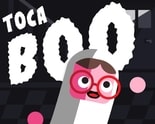
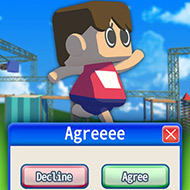
What happens when a house buyer spots you before you’ve had a chance to scare them off in Toca Boo? Nothing good, usually, and that single question drives every round. You’re a ghost defending your own haunted home from a steady stream of prospective buyers, and the game hinges on staying just out of sight until the moment you strike.
| Genre |
Ghost Survival |
| Platform |
Browser (HTML5) and Windows |
| Controls |
Hold left mouse button to move |
| Setting |
Single-floor haunted house |
Toca Boo drops you into a single-floor house that buyers enter from both the left and right sides at once, so the opening seconds already ask you to split your attention. The core loop is simple to describe and harder to execute: get close enough to frighten a buyer without drifting into their own line of sight first.
Reading Buyer Vision Cones in Toca Boo
Every buyer walking through Toca Boo has a personal vision range, separate from the ghost’s own detection range, and the two rarely match. Beginners assume proximity alone triggers a scare, then get caught wandering straight into a buyer’s eyeline instead.
The trick is approaching from an angle a buyer hasn’t checked yet, rather than a straight line toward them. Watching the direction a buyer faces before closing distance turns out to matter more than raw speed.
Several players note the vision-range rules aren’t explained anywhere in the game itself, so the early minutes amount to trial and error before the systems click, a fair complaint that shows up often in player discussion.
Left-Door, Right-Door Timing
Because buyers can walk in from either side of the house, Toca Boo constantly forces a choice between chasing the nearest threat and holding position for one you can already predict. Rushing every new arrival tends to backfire.
- Buyers entering the near door are easiest to intercept early.
- Buyers entering the far door need to be tracked by timing rather than sight.
- A buyer reaching the far end of the house unscared is the fastest way to lose a round.
Speedrun-minded players treat this like a juggling act, while more cautious players prefer clearing one side completely before turning to the other, and both approaches show up constantly in player discussion.
The Swinging Light on Toca Boo’s Menu Screen
One detail that only registers after sitting through a session is the slow swinging light fixture on the title screen, a small atmospheric touch that sets the tone before a single buyer has entered the house.
Reviewers have specifically praised the polish of the animations and art style for such a short game, and that attention to mood carries into the run itself once a buyer actually walks through the door.
Not everything lands as smoothly. The most common complaint is length, sessions end quickly, and a couple of players have flagged the losing ending sometimes repeating itself instead of resetting cleanly, a known rough edge rather than a hidden feature.
Why New Players Miss the Point in the First Minute
Without an in-game tutorial, plenty of first-time players spend their opening minute unsure what Toca Boo is even asking them to do, since holding the mouse button to move isn’t something every browser game explains up front.
Casual players often bounce off this stretch before the scare mechanic clicks, while more patient players treat the opening confusion as part of the appeal.
Players who stick with it describe a specific turning point: the first time a scare actually lands and a buyer bolts for the door, the moment that sells the whole concept better than any instructions could.
- How do you scare buyers away before they buy the house in Toca Boo? Close the distance while staying outside a buyer’s personal vision cone, then trigger the scare once you’re near enough; approaching from an angle they aren’t facing works far more reliably than a direct approach.
- Why does the ending sometimes repeat in Toca Boo? Several players have reported the losing ending looping instead of returning cleanly to the title screen, a known quirk rather than an intended feature, and one of the most discussed rough edges around the game.
- Is there a tutorial in Toca Boo? No formal one. Controls are limited to holding the left mouse button to move, but the vision-cone and detection mechanics are left for players to work out through trial and error during the first house.
Toca Boo rewards patience more than speed once the vision-cone logic clicks, and the swinging light on that title screen ends up feeling like a fitting introduction to a game that’s smaller in length than it is in atmosphere. Watch a buyer’s eyeline instead of their footsteps, and the house starts to feel like yours again.