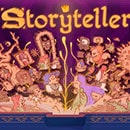
Adam does not fall in love because you told him to. He falls in love because you placed him in a panel with a scene called Love and someone else standing across from him, and Storyteller decides the rest from there. Every panel you drag a character into changes what that character wants next, and that single fact is the entire engine behind this puzzle game.
| Genre |
Narrative logic puzzle |
| Core mechanic |
Arrange characters and scenes into comic panels to match a story title |
| Chapters |
14, including Life and Death, The Cellar, Crown Intrigue, and Monsters |
| Panels per puzzle |
Varies, often 3 to 6 |
| Category |
Puzzle Games, HTML5 Games |
Storyteller hands you a title like a caption on an empty comic strip, characters standing off to the side, and a row of blank panels, then leaves the actual writing to you. There is no dialogue to type and no branching menu to pick from; instead you move Adam, Edgar, Bernard, or whichever cast the chapter has introduced into scenes, and the story updates itself based on where you put them and what happened to them one panel earlier.
How Storyteller Reads Character State Instead of Dialogue
The single mechanic that makes Storyteller click for most players is realizing that characters carry emotional and physical state from panel to panel. A character who drinks poison in panel one is dead in panel two unless something intervenes, and a character who dies will show up as a ghost in a later panel if the scene calls for one. Heartbreak, jealousy, and other emotional states persist the same way until a new event overwrites them.
Beginners in Storyteller tend to treat each panel as its own isolated puzzle, arranging a scene that looks correct in the moment without considering what state it leaves a character in for the panel after. That habit causes most early failures, because a title like “Heartbroken Spouses are Reunited” only resolves correctly if both characters actually reached heartbreak through the panels that came before, not just through the label.
Once you internalize that every panel is a cause with a consequence, the later chapters stop feeling like guesswork and start feeling like actual writing. Players in puzzle communities frequently describe the moment this clicks as the point where the game stops being a toy and starts being a language.
Why The Cellar Trips Up First-Time Players
Early in the game, chapters like Life and Death ease you into the system with a small, forgiving cast built around Adam. By the time you reach The Cellar, where Edgar falls for Bernard against a backdrop of poison, jealousy, and murder, the number of moving character states has grown enough that a wrong early panel can quietly poison a title you don’t discover you’ve failed until several panels later.
The Cellar is frequently cited as the first genuine wall in Storyteller, since its titles ask for specific emotional sequences rather than any story that technically fits. Getting a title to turn green here usually means undoing two or three panels and rethinking which character should be jealous first.
What players notice almost immediately in a chapter like this is the small ghost icon that appears once a character has died, a visual cue that quietly confirms your plan is on track or tells you, without a single line of text, that you’ve just broken the story you were building.
Multiple Solutions and the Star Objectives
Most puzzles in Storyteller accept more than one valid arrangement, and the game rewards players who find every version of a title rather than just the first one that turns green. Some panels also carry an extra star objective layered on top of the main title, asking for a specific detail, like a particular character being the one who dies, on top of the base requirement.
Chasing every star is where a lot of the replay value lives, since finding a second or third valid path through the same title forces you to look at the cast differently than your first attempt did. It is a completionist itch more than a difficulty spike, but it’s why some players spend longer on early chapters than the story length alone suggests.
Not every player cares about clearing every star, and that split is one of the more honest points of disagreement in the community: some treat the base solution as enough, while others won’t move on until a chapter is fully starred.
Monsters: The Storyteller Chapter Players Talk About Most
Chapter 12, Monsters, is the one that comes up most often when players describe Storyteller to someone who hasn’t played it. It introduces Dracula, Mina, Jon, and the Professor into vampire-hunting titles set across scenes like the Crypt and the Night, alongside werewolf and dragon-themed puzzles that ask you to juggle transformation states most earlier chapters never touch.
The Vampire puzzle here is a common sticking point, needing a minimum of five panels and forcing you to track who has been bitten, who is hunting, and who ends up cured, while a character’s state can flip between two adjacent panels. It’s the chapter several walkthroughs single out as where casual players start reaching for outside help.
By the time you reach Monsters, the game has quietly taught you every rule it needs you to know, which is why this chapter functions like a check on how well you absorbed the earlier lessons rather than a new tutorial in disguise.
The Manor, Secrets, and Justice: Storyteller’s Whodunit Stretch
Between the fairy-tale beats of Beauty and the royal drama of Crown Intrigue, Storyteller shifts into a run of chapters built more like mysteries than fables. The Manor asks you to arrange a butler’s murder and a duke’s implication so that an investigation lands on the right suspect, while Secrets and Justice extend that same detective framing into duchesses seeking justice and knights facing execution over betrayal.
These chapters read differently at the panel level, since the title is often phrased as an outcome to reverse-engineer rather than a straightforward emotional beat like heartbreak or love. Players who breeze through the fairy-tale chapters sometimes stall here because motive, not feeling, is what the panel arrangement has to prove.
From Genesis Back to the Beginning
Later chapters like Genesis loop back to Adam’s origin alongside Eve, reframing the cast you met in chapter one inside a much older, biblical-flavored set of titles about temptation and judgment. Seeing a character you’ve grown attached to placed into an entirely different kind of story is one of the small narrative payoffs Storyteller uses instead of a traditional ending cutscene.
Drama, the thirteenth chapter, leans into recognizable classical plots, Oedipus, Hamlet, and Narcissus among them, letting players who caught the references solve a panel almost instantly. Novels closes the loop by bringing Adam and Edgar’s threads back together for a final set of titles.
What holds the fourteen-chapter structure together is that nothing you did in an early chapter is wasted; the vocabulary of state and consequence you built in chapter one is exactly what chapter fourteen expects you to already know.
Questions Players Ask Before Their First Playthrough of Storyteller
- Why does my panel not match the title even though the scene looks right? The title checks the state characters are in when the panel resolves, not just which scene they’re standing in, so a character who should be heartbroken or dead by that point but isn’t yet will fail the title even if the visual arrangement looks plausible.
- How many endings or solutions does each puzzle have? Most titles accept several valid panel arrangements rather than one fixed answer, and many also include an optional star objective for players who want a more specific outcome layered on top of the base solution.
- What makes Chapter 12, Monsters, so much harder than earlier chapters? It introduces multiple overlapping states at once, bitten, hunting, cured, transformed, spread across named characters like Dracula, Mina, and the Professor, which demands the same panel-tracking discipline The Cellar first asked for, just with more moving pieces at once.
Storyteller rewards the kind of patient, backward-thinking attention that few puzzle games ask for, and once Dracula’s fangs or Edgar’s jealousy have quietly rewritten a panel you thought was finished, it’s hard to look at a blank comic strip the same way again.